


Electrochemical gas sensors convert a controlled oxidation or reduction reaction into an electrical signal related to gas concentration.
An electrochemical gas sensor detects a target gas through a controlled chemical reaction at an electrode–electrolyte interface.
In the most common amperometric design, gas diffuses into the sensor and is oxidized or reduced at the working electrode. The reaction transfers electrons and produces a current that is approximately proportional to gas concentration within the calibrated range.
Electrochemical sensors are widely used for toxic gases and oxygen because they can provide good low-concentration sensitivity with very low power consumption. They are found in portable gas detectors, fixed transmitters, residential carbon monoxide alarms, air-quality instruments and industrial monitoring systems.
Their apparent simplicity can be misleading. Accurate performance depends on gas diffusion, electrode chemistry, electrolyte condition, potentiostat design, cross-sensitivity correction, temperature compensation, calibration and the final enclosure.
Electrochemical Gas Sensor at a Glance
| Item | Explanation |
|---|---|
| Basic principle | Target gas is oxidized or reduced at an electrode |
| Common measurement mode | Amperometric current measurement |
| Typical target gases | CO, H₂S, O₂, NO₂, SO₂, NH₃, Cl₂, O₃, NO, HCN and PH₃ |
| Main electrodes | Working, reference and counter electrodes |
| Optional fourth electrode | Auxiliary electrode for baseline or environmental correction |
| Typical output | Nanoampere or microampere current |
| Main advantages | Low power, good low-ppm sensitivity, compact size and near-linear output |
| Main limitations | Finite life, cross-sensitivity, environmental dependence and calibration requirements |
| Common applications | Portable detectors, fixed gas alarms, air quality, medical and industrial systems |
What Does “Electrochemical Gas Sensor” Mean?
Electrochemical gas sensing is a broad category. A sensor can measure a change in:
- Current
- Voltage or potential
- Conductivity
- Impedance
For compact toxic-gas detectors, the most common format is the amperometric electrochemical sensor.
In an amperometric cell, the instrument controls the potential of the working electrode and measures the current produced by the target-gas reaction. Within the specified range and operating conditions, this current is approximately proportional to the amount of gas reaching the electrode.
A simplified relationship is:
I = S × C
Where:
| Symbol | Meaning |
|---|---|
| I | Sensor current |
| S | Sensitivity, often expressed in nA/ppm or μA/ppm |
| C | Gas concentration |
The actual instrument calculation must also consider zero current, temperature compensation, cross-sensitivity, gain, calibration and sensor aging.
How Does an Electrochemical Gas Sensor Work?

Target gas diffuses to the working electrode, participates in a redox reaction and produces a measurable current.
1. Target gas enters through a diffusion barrier
The sensor housing includes a capillary, porous membrane or other diffusion-control structure.
This barrier serves several purposes:
- Limits the rate at which gas reaches the electrode
- Helps define the sensor range
- Protects the internal chemistry
- Reduces sensitivity to external airflow
- May hold back particles or liquid water
The sensor is therefore often described as diffusion limited. If the gas-inlet structure changes, the sensitivity and response time may also change.
2. Gas reaches the working electrode
The working electrode contains a catalytic material selected for the intended gas reaction.
At the boundary between gas, catalyst and electrolyte, the target molecule is oxidized or reduced.
For an oxidation-type sensor, the target gas releases electrons. For a reduction-type sensor, the reaction consumes electrons.
The exact half-reaction depends on the target gas, electrode catalyst, electrolyte and applied potential.
3. Electron transfer produces a measurable current
The electrochemical reaction causes electrons to flow through the external circuit.
In a properly designed amperometric sensor, the reaction rate is controlled largely by the amount of target gas diffusing to the working electrode. This is why the current can remain approximately proportional to gas concentration.
4. The counter electrode completes the cell
The counter electrode performs the balancing half-reaction.
If the target gas is oxidized at the working electrode, another chemical species is reduced at the counter electrode. In many conventional toxic-gas cells, oxygen participates in the counter reaction.
The counter-electrode potential is generally allowed to move as needed to supply the balancing current.
5. The reference electrode controls working-electrode potential
The reference electrode provides a stable electrochemical potential.
A potentiostat compares the working-electrode potential with the reference electrode and drives the counter electrode so the working electrode remains at the required potential.
The reference electrode should carry essentially no current. If current flows through it, its potential may shift and measurement stability can deteriorate.
6. The analog front end converts current into voltage and concentration
The raw sensor current is usually very small, so the electronics commonly include:
- Potentiostat
- Transimpedance amplifier
- Low-noise operational amplifier
- Analog-to-digital converter
- Temperature sensor
- Calibration coefficients
- Filtering and fault detection
The article Overcoming the Technical Challenges of Electrochemical Gas Sensing discusses the advantages of electrochemical sensing and the importance of low-noise front-end design, temperature compensation, calibration and aging.
Working, Reference, Counter and Auxiliary Electrodes
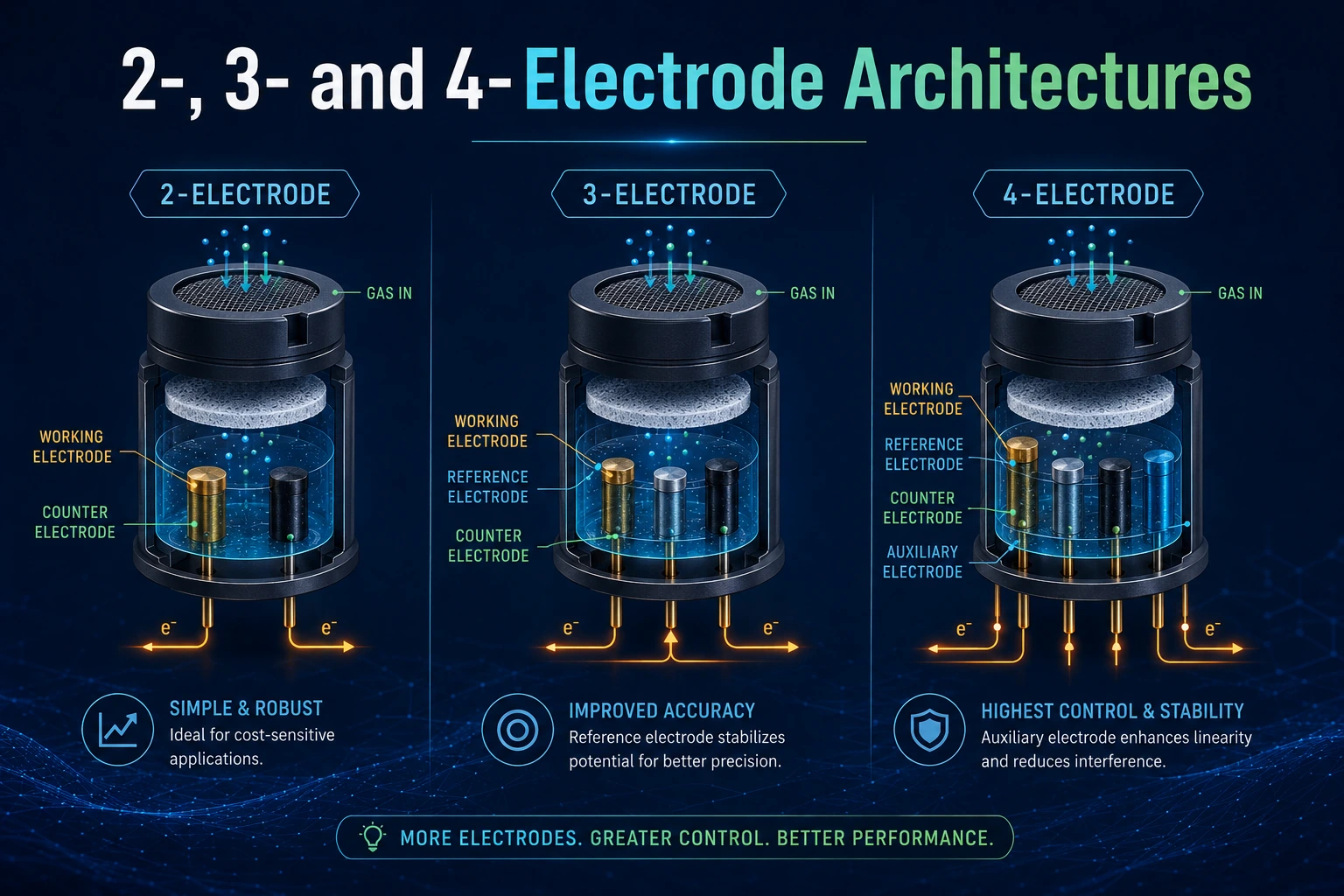
Reference and auxiliary electrodes improve potential control and baseline correction, but each architecture has different circuit requirements.
Working electrode
The working electrode is the primary gas-sensitive electrode.
Its catalyst and operating potential are selected to promote the desired oxidation or reduction reaction while limiting unwanted reactions.
The working electrode determines much of the sensor’s:
- Target-gas sensitivity
- Selectivity
- Required bias
- Response speed
- Cross-sensitivity pattern
Reference electrode
The reference electrode supplies a stable potential reference for the potentiostat.
It is normally positioned and designed to remain relatively isolated from the target-gas reaction.
Its purpose is not to generate the measurement signal.
Counter electrode
The counter electrode completes the electrochemical circuit and balances the working-electrode reaction.
It must be capable of supplying the required current without forcing the cell outside its stable operating range.
Auxiliary electrode
Some four-electrode sensors include an auxiliary electrode with chemistry similar to the working electrode but limited exposure to the target gas.
The auxiliary signal can help estimate:
- Zero-current changes
- Temperature-related baseline shift
- Background current
- Common environmental effects
The auxiliary electrode is not a universal correction channel. Compensation quality depends on electrode matching, enclosure design, temperature history and the instrument algorithm.
2-Electrode vs 3-Electrode vs 4-Electrode Sensors
| Architecture | Electrodes | Main characteristic | Typical consideration |
|---|---|---|---|
| 2-electrode | Working and counter | Simple electrochemical cell | Working potential is less independently controlled |
| 3-electrode | Working, reference and counter | Stable potentiostatic control | Standard architecture for many toxic-gas sensors |
| 4-electrode | Working, reference, counter and auxiliary | Additional baseline information | Useful for low-level measurement and temperature correction |
A third reference electrode improves stability because the electronics can maintain the working electrode at a defined potential.
A fourth auxiliary electrode provides another signal for estimating baseline effects, particularly in low-ppb air-quality measurements.
However, the number of electrodes alone does not determine sensor quality. Electrode materials, electrolyte, diffusion barrier, manufacturing consistency, circuit design and calibration remain equally important.
Biased and Unbiased Electrochemical Sensors
Some electrochemical sensors operate with the working electrode held at the same potential as the reference electrode. These are commonly described as unbiased sensors.
Other gases require the working electrode to be held at a positive or negative offset relative to the reference electrode.
These are biased sensors.
Bias can improve reaction rate or selectivity, but it creates important integration requirements:
- The bias must be maintained continuously in some products
- Disconnecting the sensor may require a long stabilization period
- Incorrect bias can change sensitivity and cross-sensitivity
- The analog front end must support the specified polarity and voltage
- Storage or transport instructions may include a shorting clip or bias circuit
Never assume that sensors with the same pin arrangement require the same bias.
Which Gases Can Electrochemical Sensors Detect?
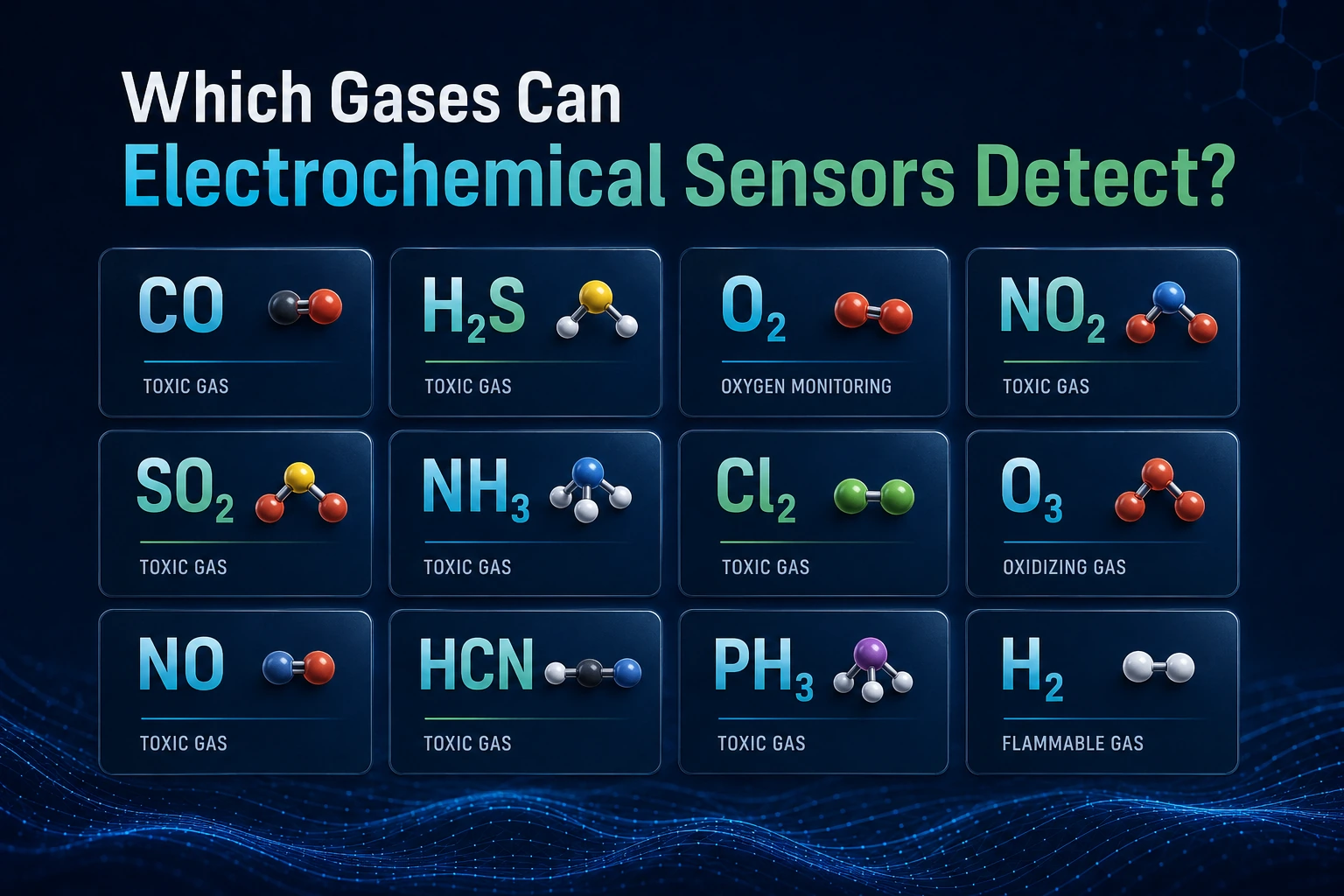
Electrochemical sensors are widely used for toxic, oxidizing and reducing gases, but each sensor is designed for a specific gas and range.
Electrochemical gas sensors are especially common for toxic, reactive and oxygen-related measurements.
| Target gas | Common use | Important consideration |
|---|---|---|
| Carbon monoxide, CO | Portable detectors, residential alarms and combustion safety | Hydrogen and alcohol interference may matter in some designs |
| Hydrogen sulfide, H₂S | Oil and gas, wastewater, mining and biogas | High exposure can overload filters or temporarily affect recovery |
| Oxygen, O₂ | Confined-space and medical monitoring | Oxygen sensors may use galvanic or amperometric chemistry |
| Nitrogen dioxide, NO₂ | Air quality, combustion and industrial safety | Ozone cross-sensitivity can be significant |
| Sulfur dioxide, SO₂ | Combustion, industrial emissions and safety | Humidity and gas-mixture effects require evaluation |
| Ammonia, NH₃ | Refrigeration, agriculture and industrial safety | Electrolyte consumption and environmental effects can limit life |
| Chlorine, Cl₂ | Water treatment, chemical processing and safety | Reactive gas sampling materials strongly affect response |
| Ozone, O₃ | Air quality, sterilization and process systems | NO₂ and other oxidants may interfere |
| Nitric oxide, NO | Emissions, medical and industrial measurement | Many NO sensors require a positive bias |
| Hydrogen cyanide, HCN | Fire, mining and chemical safety | Cross-sensitivity and filter selection are critical |
| Phosphine, PH₃ | Semiconductor, fumigation and industrial safety | Low-level toxic-gas performance is application specific |
| Hydrogen, H₂ | Battery, process and safety applications | Range and cross-sensitivity depend strongly on chemistry |
A sensor designed for one gas should not be treated as a general-purpose chemical analyzer.
Even when two gases produce similar redox reactions, their sensitivity, response time and cross-sensitivity may be very different.
Are Electrochemical Sensors Selective?
Electrochemical sensors can be designed for useful selectivity, but they are not perfectly specific.
A sensor responds when another gas can:
- Reach the working electrode
- Participate in an electrochemical reaction
- React at the selected electrode potential
- Pass through any internal chemical filter
This unwanted response is called cross-sensitivity.
Cross-Sensitivity Explained
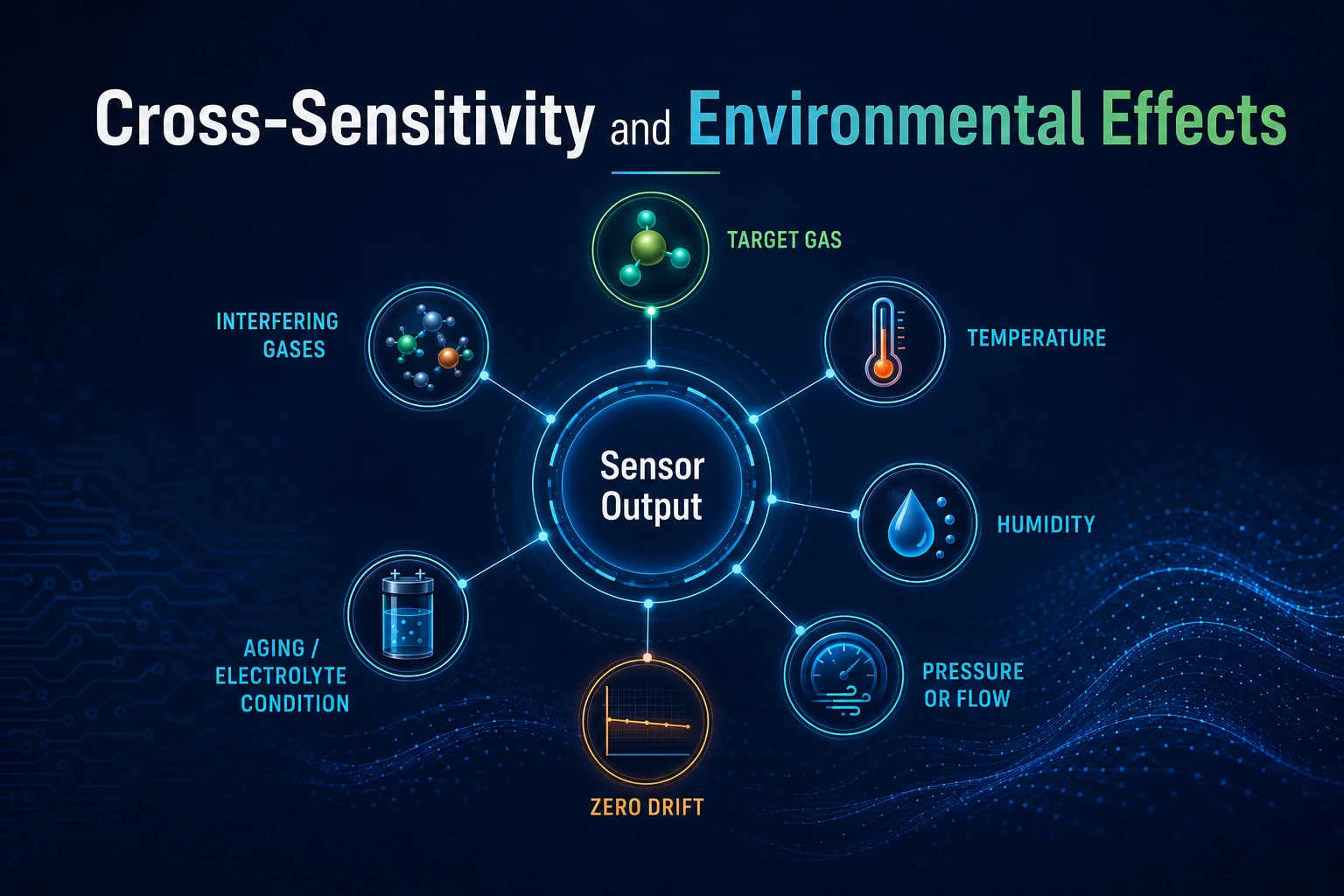
Real-world readings reflect the target gas, interfering gases, environmental conditions, sensor aging and signal processing.
Manufacturers often publish a cross-sensitivity table showing the apparent target-gas response produced by a specified concentration of another gas.
For example, an interfering gas may produce:
- Positive response
- Negative response
- Delayed response
- Temporary poisoning
- Filter consumption
- Baseline shift
A cross-sensitivity table should not be interpreted as a universal correction factor.
Actual interference may depend on:
- Gas concentration
- Exposure duration
- Temperature
- Humidity
- Sensor age
- Bias voltage
- Gas mixture
- Internal filter condition
- Flow and enclosure design
For safety-critical instruments, test the complete detector with the relevant gas mixture rather than relying only on individual-gas laboratory data.
Internal Chemical Filters
Some electrochemical sensors include filters that remove or reduce interfering gases before they reach the working electrode.
Filters may improve selectivity against gases such as:
- Hydrogen sulfide
- Sulfur dioxide
- Nitrogen dioxide
- Ozone
- Alcohol vapors
- Acid gases
- Hydrocarbons
Filters have finite capacity.
Repeated exposure to high concentrations of an interfering gas can consume the filter and change sensor behavior later in its operating life.
Oxygen Dependence
Many conventional toxic-gas electrochemical cells use oxygen reduction at the counter electrode.
In normal ambient air, enough oxygen is usually available to balance the working-electrode reaction.
In oxygen-deficient or oxygen-free gas streams, the counter electrode may follow a different reaction pathway. This can change:
- Sensitivity
- Linearity
- Recovery
- Baseline
- Long-term stability
Do not assume a sensor can accurately measure toxic gas in nitrogen, biogas, inert process gas or a sealed oxygen-depleted chamber unless the manufacturer has specifically tested that condition.
Temperature Effects
Temperature can influence:
- Electrode reaction rate
- Electrolyte conductivity
- Gas diffusion
- Zero current
- Sensitivity
- Reference-electrode potential
- Evaporation and water balance
A sensor may produce a large zero shift during rapid temperature changes even when the final steady-state temperature compensation is good.
Temperature correction may use:
- Manufacturer correction tables
- Thermistor or digital temperature sensor
- Auxiliary electrode
- Polynomial or lookup-table algorithms
- Application-specific field calibration
Humidity Effects
Electrochemical cells contain an electrolyte and typically exchange water vapor with the environment through the gas inlet.
Long exposure to very dry air can cause water loss and electrolyte concentration changes.
Long exposure to very humid air can cause water uptake, swelling, leakage or reduced internal gas volume.
Rapid humidity changes can also create transient output changes.
The specified relative-humidity range should therefore be interpreted together with:
- Exposure duration
- Temperature
- Condensation risk
- Storage conditions
- Enclosure ventilation
Pressure, Airflow and Sampling Effects
Electrochemical sensors are often diffusion controlled, but the finished instrument can still be influenced by:
- Pressure pulses
- Pump flow
- Fan position
- Enclosure vents
- Membranes
- Tubing
- Gas adsorption on materials
- Sample humidity
- Dead volume
Reactive gases such as chlorine, ozone, ammonia and hydrogen sulfide can be lost on unsuitable tubing, adhesives, filters or enclosure surfaces.
Gas-path materials are therefore part of the measurement system.
Advantages of Electrochemical Gas Sensors
Very low power consumption
The sensing reaction usually does not require a continuously heated element.
This makes electrochemical sensors well suited to:
- Battery-powered portable detectors
- Wearable monitors
- Wireless transmitters
- Residential alarms
- Remote monitoring nodes
Biased sensors and signal-processing electronics still consume power, but total demand is often far below heated semiconductor or catalytic technologies.
Good low-concentration sensitivity
Electrochemical sensors can measure many toxic gases in ppm or ppb ranges.
This makes them useful for occupational exposure, leak detection and indicative air-quality monitoring.
Approximately linear output
Within the specified range, the measured current is often approximately proportional to gas concentration.
This simplifies calibration compared with strongly nonlinear sensing principles.
Compact size
Electrochemical cells are available in conventional cylindrical packages, miniature formats and printed planar structures.
Gas-specific chemistry
Catalyst, electrolyte, bias and filters can be optimized for a target gas.
This can provide better selectivity than broad-response gas sensors, although cross-sensitivity remains important.
Limitations of Electrochemical Gas Sensors
| Limitation | Why it matters | Typical mitigation |
|---|---|---|
| Finite operating and shelf life | Electrolyte, electrodes and filters change over time | Follow storage limits, track age and replace on schedule |
| Cross-sensitivity | Other gases can create false positive or negative readings | Filters, sensor arrays, algorithms and application testing |
| Temperature dependence | Zero and sensitivity change with temperature | Temperature measurement and compensation |
| Humidity dependence | Electrolyte water balance can change | Appropriate enclosure, storage and environmental limits |
| Oxygen dependence | Counter reaction may change in oxygen-deficient gas | Use validated chemistry or another sensing method |
| Small signal current | Noise, leakage and PCB contamination can dominate | Low-noise potentiostat and careful PCB design |
| Over-range exposure | High gas concentration can cause saturation or slow recovery | Exposure management, diagnostics and recovery testing |
| Calibration requirement | Sensitivity and zero change with time | Bump testing, zero and span calibration |
| Reactive-gas sampling losses | Tubing and materials can absorb target gas | Use validated gas-path materials |
Electrochemical vs Other Gas Sensor Technologies
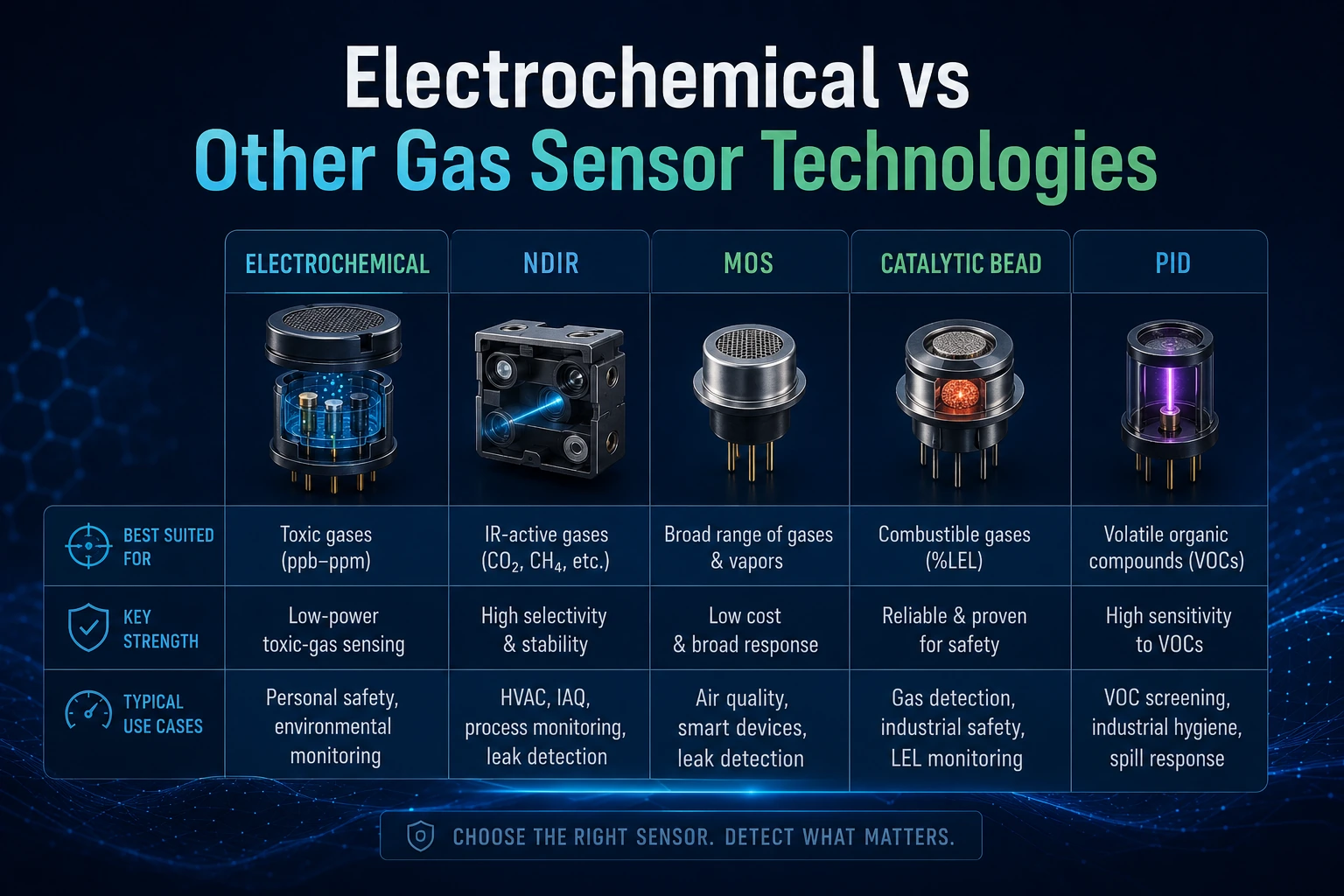
Electrochemical sensors excel in low-power toxic-gas measurement, while other principles are better suited to different gas groups and ranges.
| Technology | Typical targets | Main strengths | Main limitations |
|---|---|---|---|
| Electrochemical | CO, H₂S, O₂, NO₂, SO₂, NH₃ and other toxic gases | Low power and good low-ppm sensitivity | Finite life, cross-sensitivity and environmental dependence |
| NDIR | CO₂, CH₄, refrigerants and IR-active gases | Stable, selective and non-consumptive | Not suitable for every gas and requires optics |
| Metal-oxide semiconductor | VOCs and broad gas indicators | Compact, rugged and economical | Heater power, drift and limited selectivity |
| Catalytic bead | Combustible gases in %LEL | Established industrial safety method | Requires oxygen and may be poisoned |
| Photoionization detector | Broad VOC screening | High sensitivity to many ionizable VOCs | Does not directly identify individual compounds |
Neither electrochemical nor NDIR is universally better.
Electrochemical technology is usually a strong candidate for low-power toxic-gas and oxygen measurement.
NDIR is usually a stronger candidate for gases with useful infrared absorption bands, including carbon dioxide, methane and many refrigerants.
Common Applications
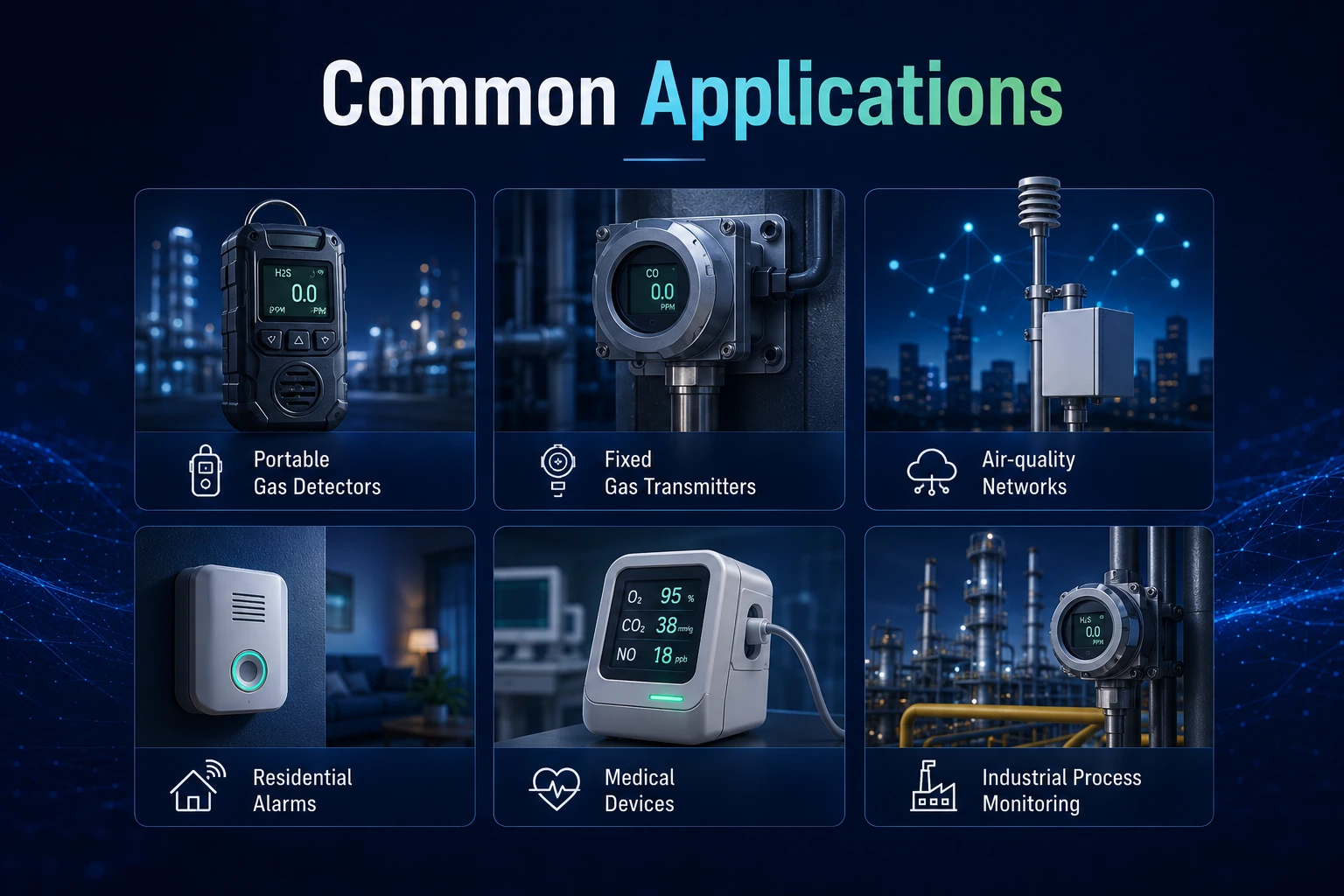
Electrochemical cells are used in portable safety instruments, fixed monitoring, air-quality networks, alarms and specialized equipment.
Portable gas detectors
Personal and handheld instruments use electrochemical sensors for:
- Carbon monoxide
- Hydrogen sulfide
- Oxygen
- Sulfur dioxide
- Nitrogen dioxide
- Ammonia
- Chlorine
- Hydrogen cyanide
Low power consumption is especially important in portable multi-gas detectors.
Fixed gas transmitters
Fixed instruments monitor:
- Chemical plants
- Wastewater facilities
- Oil and gas sites
- Battery rooms
- Refrigeration plants
- Laboratories
- Water-treatment facilities
- Warehouses and process areas
Residential carbon monoxide alarms
Electrochemical CO sensors are widely used in residential and commercial carbon monoxide alarms because they can operate at low power and respond across relevant concentration ranges.
Air-quality sensor networks
Electrochemical sensors are used in compact air-quality nodes for gases such as CO, NO₂, O₃ and SO₂.
However, lower-cost air sensors are not automatically equivalent to regulatory reference analyzers.
The U.S. EPA Air Sensor Toolbox publishes performance evaluations showing that results vary by sensor, pollutant, environment and calibration method.
Medical and healthcare equipment
Electrochemical cells may be used in:
- Oxygen monitors
- Respiratory equipment
- Anesthesia systems
- Sterilization monitoring
- Breath-analysis research
Medical applications require specialized accuracy, biocompatibility, alarm and regulatory design.
Industrial process and emissions systems
Electrochemical sensors can support:
- Leak detection
- Combustion monitoring
- Stack or ambient emissions screening
- Process-gas measurement
- Scrubber and treatment control
- Chemical storage monitoring
How to Select an Electrochemical Gas Sensor
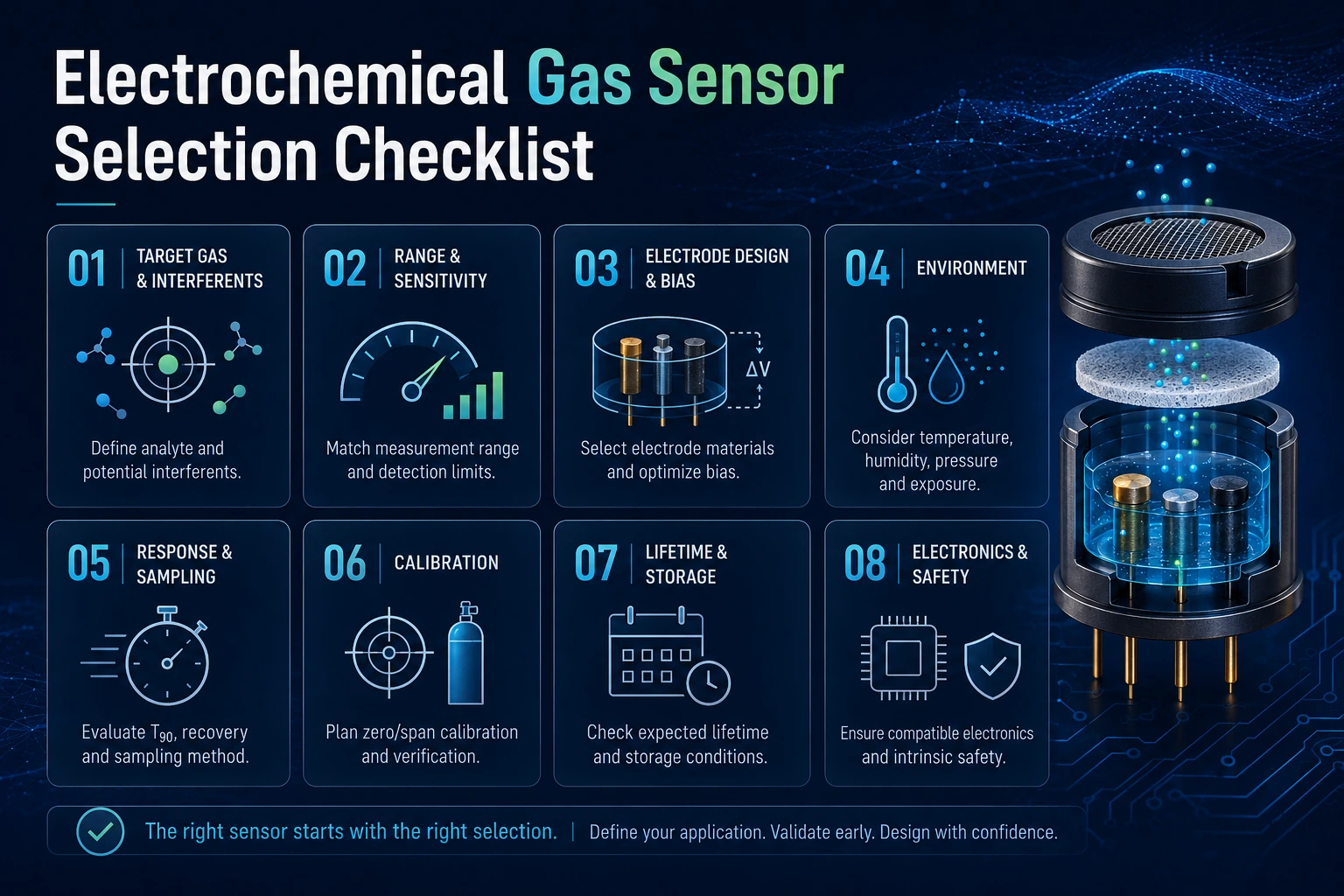
Sensor selection should include cross-sensitivity, bias, environmental conditions, calibration, lifetime and front-end electronics.
1. Define the exact target gas
Specify:
- Chemical formula
- Expected concentration range
- Normal background level
- Alarm thresholds
- Interfering gases
- Oxygen availability
- Process pressure and humidity
“Acid gas,” “toxic gas” or “air quality” is not a sufficiently precise target specification.
2. Select the required range and sensitivity
Check:
- Full-scale range
- Sensitivity in nA/ppm or μA/ppm
- Resolution
- Noise
- Limit of detection
- Over-range tolerance
- Recovery after high exposure
A wider range may reduce useful low-level signal.
3. Check the electrode architecture
Determine whether the sensor uses:
- Two electrodes
- Three electrodes
- Four electrodes
- Dual independent cells
- Integrated compensation electronics
Do not assume that a fourth electrode automatically provides a calibrated concentration output. The instrument still needs an appropriate algorithm.
4. Confirm required bias voltage
Check:
- Bias magnitude
- Bias polarity
- Whether bias must be continuously maintained
- Stabilization time after power-up
- Shorting requirements during storage
- Allowed disconnect duration
5. Review cross-sensitivity and filters
Request:
- Cross-sensitivity table
- Test concentrations
- Exposure duration
- Filter type and capacity
- Known poisoning gases
- Negative interference behavior
- Mixed-gas test data
6. Evaluate environmental conditions
Compare the application with:
- Operating temperature
- Storage temperature
- Relative humidity
- Condensation
- Pressure
- Oxygen level
- Vibration
- Orientation
- Expected chemical vapors
7. Compare response time correctly
T90 is the time required to reach 90% of the final response under defined test conditions.
Actual instrument response may be slower because of:
- Protective membrane
- Dust filter
- Hydrophobic barrier
- Enclosure diffusion
- Pump and tubing
- Software averaging
8. Plan calibration and field verification
Determine:
- Factory calibration method
- Recommended zero gas
- Recommended span gas
- Calibration concentration
- Flow rate
- Stabilization time
- Calibration interval
- Bump-test procedure
- End-of-life criteria
9. Design the electronics around the sensor
The analog front end should account for:
- Sensor current polarity
- Required bias
- Transimpedance gain
- Input bias current
- Offset voltage
- PCB leakage
- Electromagnetic interference
- ADC resolution
- Temperature measurement
- Sensor fault conditions
10. Verify safety and regulatory requirements
Depending on the product, requirements may include:
- Occupational gas detector standards
- Residential alarm standards
- Intrinsic safety
- Hazardous-location approval
- EMC
- Functional safety
- Medical-device requirements
- Environmental monitoring protocols
The sensor component alone does not certify the finished instrument.
Calibration, Bump Testing and Zero Adjustment
What is a bump test?
A bump test exposes the detector to gas to confirm that:
- Gas reaches the sensor
- The sensor responds
- Electronics are working
- Audible, visual or vibration alarms activate
- Flow path is not blocked
A bump test is not necessarily a full calibration.
What is zero calibration?
Zero calibration establishes the baseline in clean air or a specified zero gas.
Zero gas must not contain target gas or interfering gases that affect the sensor.
What is span calibration?
Span calibration exposes the instrument to a certified target-gas concentration and adjusts sensitivity.
Calibration conditions should follow the instrument manufacturer’s instructions for:
- Gas concentration
- Flow
- Pressure
- Humidity
- Time
- Accessories
Why field calibration matters
Sensor sensitivity changes with:
- Age
- Temperature history
- Humidity history
- Gas exposure
- Filter consumption
- Electrolyte condition
- Mechanical stress
A stored factory coefficient cannot guarantee permanent accuracy.
Sensor Lifetime and Storage
Electrochemical sensor life is not one universal number.
It depends on:
- Target-gas chemistry
- Electrolyte
- Package and diffusion barrier
- Temperature
- Humidity
- Exposure history
- Filter loading
- Storage duration
- Bias condition
- Oxygen availability
Datasheets may specify:
- Shelf life
- Expected operating life
- Sensitivity drift
- Zero drift
- Warranty period
- Recommended storage conditions
Do not confuse shelf life with operating life.
A sensor stored in poor temperature or humidity conditions may degrade before installation.
Common Electrochemical Sensor Design Mistakes
Treating cross-sensitivity as a fixed correction
Interference response may change with concentration, temperature, age and gas mixture.
Using the wrong bias
Incorrect bias can change sensitivity, baseline, selectivity and recovery.
Ignoring PCB leakage current
At nanoampere signal levels, flux residue, moisture and contamination can create measurement errors comparable to the sensor signal.
Placing the temperature sensor too far away
The compensation temperature should represent the electrochemical cell, not only the main processor board.
Adding an untested membrane or filter
A protective layer can reduce sensitivity and slow response.
Using unsuitable tubing for reactive gases
Chlorine, ozone, ammonia and hydrogen sulfide may be lost on common materials before reaching the sensor.
Assuming the bare-cell T90 equals instrument T90
Enclosure and sampling design may dominate response time.
Calibrating only at room temperature
A single room-temperature calibration does not characterize field performance across wide environmental conditions.
Frequently Asked Questions
What is an electrochemical gas sensor?
An electrochemical gas sensor is a device in which a target gas participates in a controlled oxidation or reduction reaction at an electrode. The resulting current, voltage or impedance change is converted into a gas concentration reading.
How does an amperometric electrochemical gas sensor work?
Gas diffuses through a controlled barrier to the working electrode. A redox reaction transfers electrons, the counter electrode completes the reaction, and a potentiostat maintains the required working-electrode potential. The measured current is approximately proportional to gas concentration within the specified range.
Which gases can electrochemical sensors detect?
Common targets include carbon monoxide, hydrogen sulfide, oxygen, nitrogen dioxide, sulfur dioxide, ammonia, chlorine, ozone, nitric oxide, hydrogen cyanide, phosphine and selected other toxic or reactive gases.
What are the working, reference and counter electrodes?
The working electrode catalyzes the target-gas reaction. The reference electrode provides a stable electrochemical potential without carrying measurement current. The counter electrode completes the electrochemical reaction and supplies the balancing current.
What is a four-electrode electrochemical gas sensor?
A four-electrode sensor adds an auxiliary electrode, often used to estimate background or zero-current changes caused by temperature and other environmental effects.
Do electrochemical gas sensors require oxygen?
Many conventional toxic-gas cells depend on oxygen reduction at the counter electrode. Operation in oxygen-deficient or oxygen-free samples can change the electrochemical balance and may produce inaccurate readings unless the sensor is specifically designed and validated for that condition.
What is cross-sensitivity?
Cross-sensitivity is the response of a gas sensor to gases other than its intended target. It can create positive or negative errors.
How often should an electrochemical sensor be calibrated?
The correct interval depends on the gas, instrument, environment, regulations and manufacturer instructions. Gas detection instruments commonly require periodic bump testing and zero or span calibration using certified gas.
How long does an electrochemical gas sensor last?
Operating life varies by gas chemistry, electrolyte, environment, exposure history and storage. Check the specific datasheet for shelf life, expected operating life, drift and replacement criteria.
Is an electrochemical sensor better than NDIR?
Neither technology is universally better. Electrochemical sensors are often preferred for low-power ppm or ppb measurement of toxic gases and oxygen. NDIR is often preferred for infrared-active gases such as carbon dioxide, methane and refrigerants.
Conclusion
Electrochemical gas sensors are among the most important technologies for low-power toxic-gas and oxygen detection.
Their core principle is straightforward: gas diffuses to a working electrode, participates in an oxidation or reduction reaction and produces an electrical signal related to concentration.
Reliable measurement requires much more than the sensor cell alone.
Electrode architecture, bias voltage, oxygen availability, cross-sensitivity, temperature, humidity, sampling materials, low-noise electronics, calibration and instrument design all affect the final result.
The best selection process begins with the exact target gas and field environment, then evaluates the complete sensor and instrument as one measurement system.
