


How Does an NDIR Sensor Work?
An NDIR sensor converts wavelength-selective infrared absorption into a compensated concentration reading.
A practical NDIR measurement can be divided into six steps.
1. The infrared source emits energy
The source may be a miniature lamp, MEMS thermal emitter or infrared LED.
It is commonly pulsed so the electronics can distinguish the controlled source signal from background radiation and low-frequency drift.
2. The light travels through a gas chamber
Ambient air or a conditioned gas sample enters the chamber through diffusion, convection or pump-driven flow.
The chamber defines the optical path length and strongly affects sensitivity, response time and measurement range.
3. The target gas absorbs selected wavelengths
When the emitted infrared spectrum overlaps an absorption band of the target gas, part of the energy is absorbed.
As target-gas concentration increases, more infrared energy is generally absorbed and less reaches the active detector.
4. An optical filter isolates the measurement band
The filter passes a narrow wavelength band associated with the target gas while blocking much of the unwanted spectrum.
Filter center wavelength and bandwidth directly affect sensitivity, selectivity and cross-interference.
5. The detector converts infrared energy into an electrical signal
Thermopiles, pyroelectric detectors and suitable photodiodes are used in different NDIR architectures.
The detector output is amplified, digitized and compared with calibration information.
6. Compensation converts the signal into concentration
Temperature, pressure, source aging, detector drift, gas flow and other influences must be addressed through hardware design, calibration coefficients and software.
A stable optical signal is not automatically an accurate gas-concentration value.
The Beer–Lambert Law in NDIR Measurement
The ideal relationship between transmitted infrared intensity and gas concentration is commonly expressed as:
I = I₀ × e⁻ᵏᴸᶜ
| Symbol | Meaning | Engineering significance |
|---|---|---|
| I | Measured infrared intensity | Energy reaching the detector after passing through the gas |
| I₀ | Reference or zero-gas intensity | Baseline signal without target-gas absorption |
| k | Absorption coefficient | Depends on the gas, wavelength, filter and conditions |
| L | Optical path length | Longer paths can improve low-concentration sensitivity |
| C | Gas concentration | The quantity the sensor estimates |
Real NDIR systems usually require modified calibration curves rather than a single ideal equation.
Optical-filter bandwidth, absorption-line structure, reflections, detector behavior and scattering can introduce nonlinearity. Manufacturers therefore calibrate the complete sensor against known gas concentrations.
A longer optical path generally improves absorption at low concentrations, but it can approach signal saturation at high concentrations. Compact modules often use folded or reflective chambers to increase effective path length without making the housing physically long.
Main Components of an NDIR Sensor
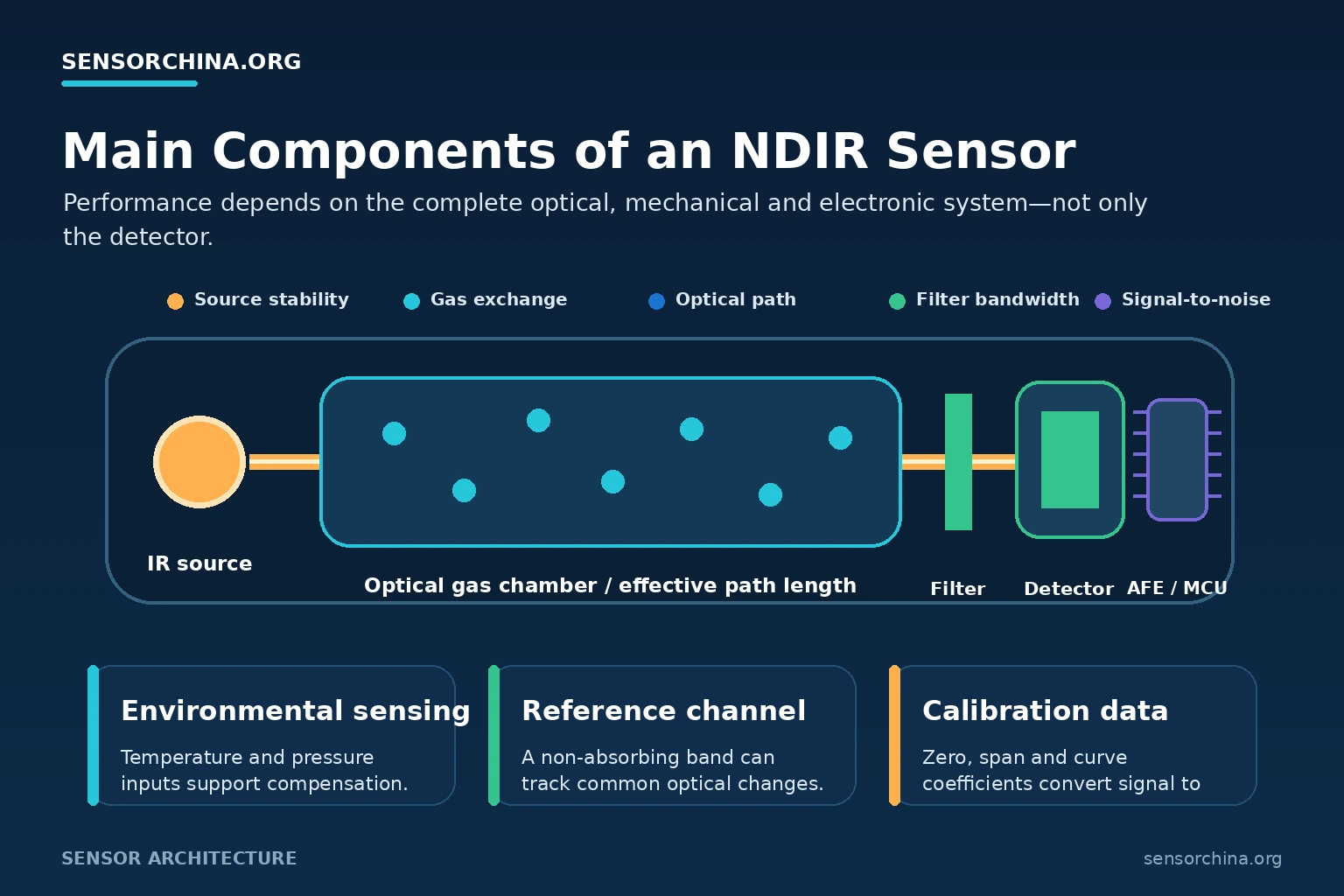
The optical path, detector, filter, environmental sensors and signal processing all influence NDIR performance.
| Component | Function | Important design questions |
|---|---|---|
| Infrared source | Produces the measurement radiation | Output spectrum, aging, pulse operation, power and warm-up |
| Gas chamber | Defines sample volume and optical path | Path length, reflectivity, gas exchange, dead volume and contamination |
| Optical filter | Selects the target absorption band | Center wavelength, bandwidth, out-of-band rejection and temperature stability |
| Active detector | Measures the gas-sensitive wavelength | Sensitivity, noise, response time and spectral compatibility |
| Reference channel | Measures a minimally absorbed band | Common-mode correction for source and optical changes |
| Temperature and pressure sensing | Provides environmental data | Compensation range, placement and update rate |
| Analog front end and MCU | Amplifies, digitizes and calculates concentration | Noise, resolution, filtering, diagnostics and algorithms |
| Gas inlet or sampling system | Delivers representative gas to the chamber | Diffusion, membrane, fan, pump, flow and enclosure effects |
Which Gases Can NDIR Sensors Detect?
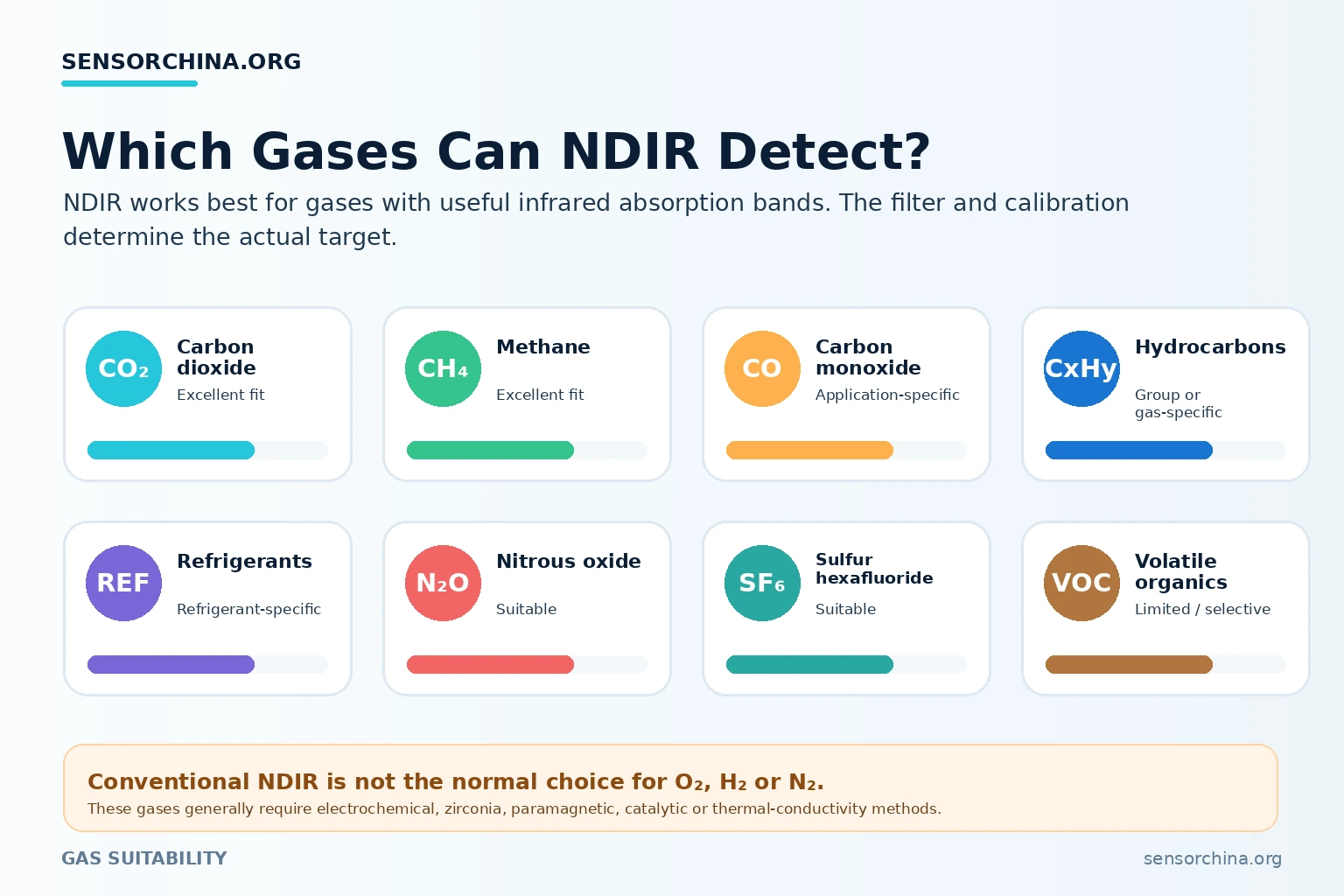
NDIR is suitable for gases with useful infrared absorption bands; the optical filter and calibration define the actual target.
NDIR is suitable when the target molecule has a sufficiently strong and useful infrared absorption band within the source and detector range.
| Gas or gas group | NDIR suitability | Selection note |
|---|---|---|
| Carbon dioxide, CO₂ | Excellent | One of the most common NDIR targets |
| Methane, CH₄ | Excellent | Common in combustible-gas, biogas and process monitoring |
| Carbon monoxide, CO | Suitable with dedicated design | Requires a matched source, filter, path length and calibration |
| Hydrocarbons | Suitable but response varies | Methane calibration should not be assumed accurate for propane or mixed fuels |
| Refrigerants | Suitable and refrigerant-specific | Filter and calibration must match the intended refrigerant |
| Nitrous oxide, N₂O | Suitable | Used in medical, environmental and industrial analysis |
| Sulfur hexafluoride, SF₆ | Suitable | Used in leak detection and electrical-industry applications |
| Volatile organic compounds | Limited or compound-specific | One broad NDIR channel cannot identify every VOC in a mixture |
Which gases are not normally measured by conventional NDIR?
Conventional NDIR is generally not used for:
- Oxygen, O₂
- Hydrogen, H₂
- Nitrogen, N₂
These gases do not provide the strong practical mid-infrared absorption bands used by standard NDIR sensors.
Other technologies are normally selected, including electrochemical, zirconia, paramagnetic, catalytic or thermal-conductivity sensing.
This boundary is especially important in combustible-gas safety. An infrared hydrocarbon sensor may detect methane while remaining insensitive to hydrogen.
Single-Channel vs Dual-Channel NDIR Sensors

A reference channel can track source aging and common optical losses, improving long-term robustness.
NDIR terminology is not completely uniform.
“Dual channel” may refer to two detector elements, two filtered wavelengths, two optical paths or, in some instruments, two measurement cells.
The practical question is whether the sensor has a reference measurement that is minimally affected by the target gas.
| Feature | Single-channel NDIR | Dual-channel or active-reference NDIR |
|---|---|---|
| Optical data | Active absorption band | Active band plus a reference band or path |
| Source-aging visibility | Limited; handled through calibration and models | Better common-mode tracking |
| Dust and optical loss | May resemble gas absorption | Some common optical changes can be ratio-corrected |
| Complexity and cost | Usually lower | Usually higher |
| Best suited for | Cost-sensitive or controlled environments | Long-life or demanding applications |
A reference channel improves robustness, but it cannot automatically correct uneven contamination, condensation, gas-specific interference, poor gas exchange or an unsuitable calibration curve.
Advantages of NDIR Sensors
High gas selectivity
The optical filter can target a characteristic absorption band, giving NDIR better selectivity than broadly responsive technologies such as many metal-oxide semiconductor sensors.
Selectivity is not absolute. Water vapor and gases with overlapping absorption bands may still interfere.
Non-consumptive measurement
NDIR does not normally consume the target gas, an electrolyte or a catalytic surface during measurement.
This can support longer service life than sensing technologies that depend on chemical consumption.
Good long-term stability
Stable optical components, reference measurements and compensation algorithms can reduce drift over time.
NDIR is frequently selected for continuous measurement in HVAC, gas-monitoring and process-control systems.
Wide measurement range
NDIR systems can be designed for low ppm, percentage-volume or combustible-gas ranges.
The optical path, filter, detector and calibration curve must be matched to the required concentration range.
No oxygen requirement for the optical measurement
Infrared absorption does not require oxygen to support a chemical reaction.
This can be useful in inert or oxygen-deficient atmospheres when the complete instrument is suitable for the operating environment.
Resistance to catalytic poisoning
NDIR does not rely on the catalyst used in catalytic-bead sensors.
However, its optical surfaces can still be affected by dust, oil, condensation and deposits.
Limitations of NDIR Sensors
| Limitation | Why it matters | Typical mitigation |
|---|---|---|
| Not suitable for every gas | O₂, H₂ and N₂ are not normal conventional NDIR targets | Select another sensing principle |
| Optical contamination | Dust, oil or deposits reduce transmitted light | Filters, protected optics, reference channel and maintenance |
| Condensation | Water droplets can cause abrupt optical loss | Thermal design, hydrophobic protection and correct placement |
| Spectral interference | Other gases may absorb inside the filter band | Narrower filters, additional channels and mixture calibration |
| Temperature and pressure effects | Gas density and component output change | Environmental sensing and compensation |
| Power consumption | Traditional lamps may require significant current | Duty cycling, MEMS emitters or IR LEDs |
| Cost and packaging | Filters, detectors and optical alignment add complexity | Application-specific integration and volume manufacturing |
What Affects NDIR Sensor Accuracy?
Temperature
Temperature can affect source output, detector sensitivity, electronic offset, chamber dimensions and gas density.
An operating-temperature range does not necessarily mean the stated room-temperature accuracy applies across the entire range.
Pressure and altitude
Absorption depends on the number of target molecules within the optical path.
Changing atmospheric or process pressure can therefore change the measurement signal. Confirm whether pressure is measured, assumed or corrected by the host system.
Humidity and water vapor
Water vapor absorbs infrared energy in several spectral regions.
Good filter selection reduces interference, but high-accuracy systems may still require humidity characterization or correction.
Dust, aerosols and condensation
Particles scatter light and deposits block it.
Condensation is especially disruptive because it can appear quickly and unevenly across optical surfaces. The final enclosure and gas inlet should therefore be treated as part of the sensing system.
Gas flow and response filtering
A fast detector does not guarantee a fast product response.
Membranes, chamber volume, enclosure vents, sampling lines, pumps and digital averaging may dominate the final response time.
NDIR vs Other Gas-Sensing Technologies
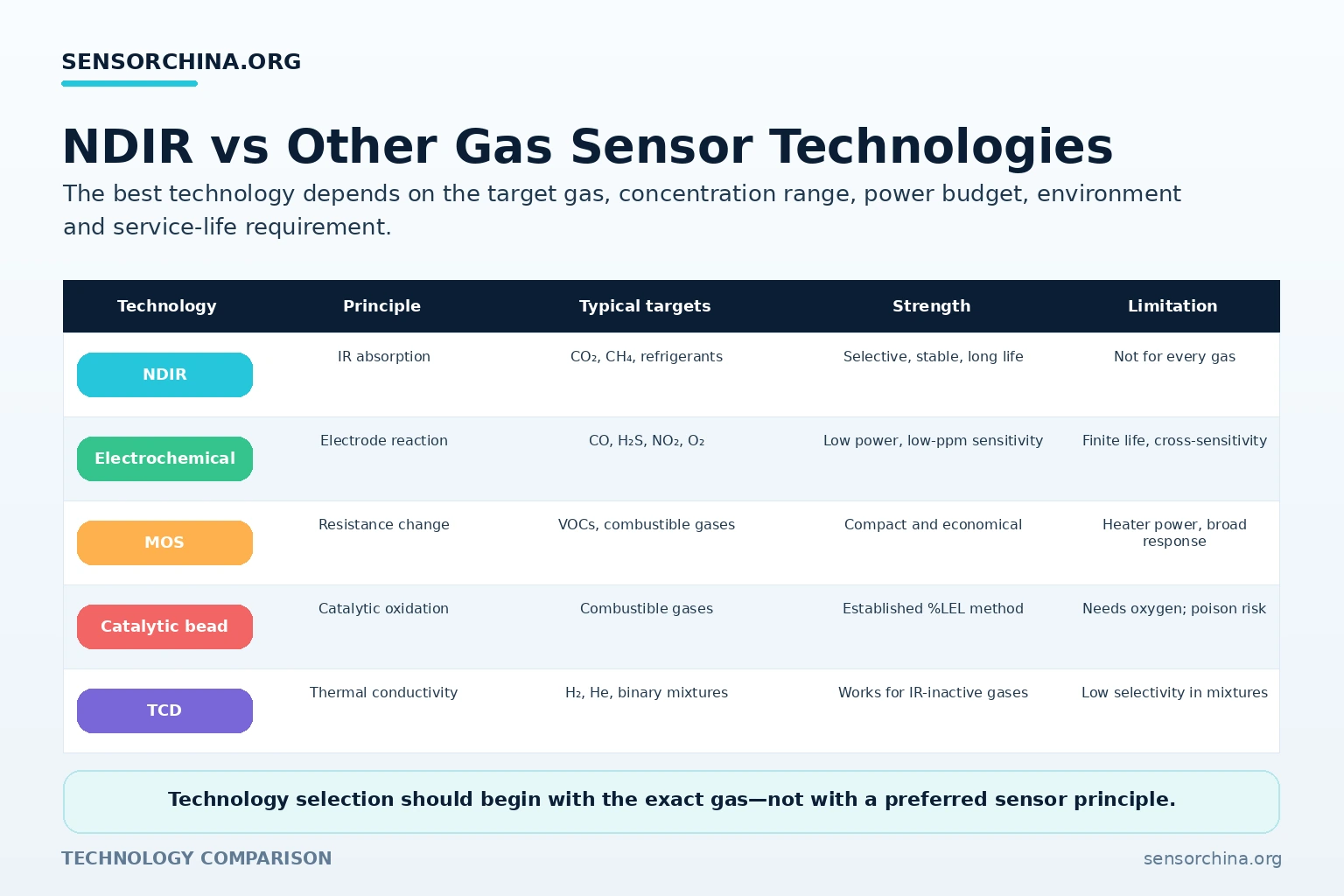
The correct sensing technology depends on the exact gas, range, environment, power budget and lifetime requirement.
| Technology | Typical target gases | Main advantages | Main limitations |
|---|---|---|---|
| NDIR | CO₂, CH₄, refrigerants and selected IR-active gases | Selective, stable and non-consumptive | Not suitable for every gas; optical contamination and cost |
| Electrochemical | CO, H₂S, NO₂, SO₂, O₂ and other toxic gases | Low power and strong low-ppm performance | Finite electrolyte life and cross-sensitivity |
| Metal-oxide semiconductor | VOCs and combustible-gas indicators | Compact, rugged and economical | Heater power, drift and limited selectivity |
| Catalytic bead | Many combustible gases | Established %LEL measurement | Requires oxygen; catalyst poisoning and inhibition |
| Thermal conductivity | Hydrogen, helium and controlled binary mixtures | Can measure IR-inactive gases | Low selectivity in complex mixtures |
No sensing technology is universally superior.
The correct choice depends on the target gas, concentration range, environment, power budget, expected lifetime and safety requirements.
Common NDIR Sensor Applications
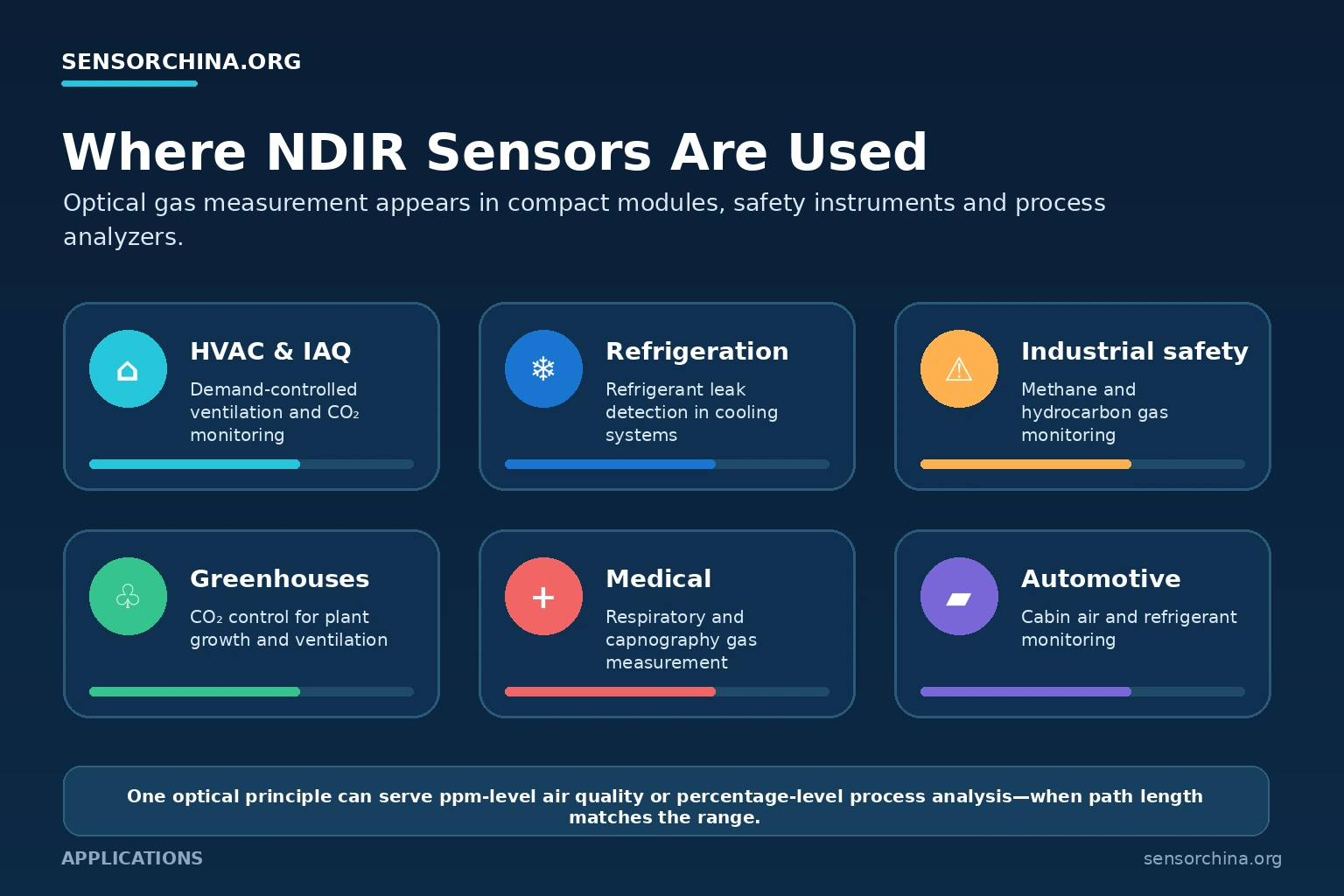
NDIR sensors are used in air quality, refrigerant safety, industrial monitoring, agriculture, medical and automotive systems.
Indoor air quality and HVAC
NDIR CO₂ modules are widely used in:
- Demand-controlled ventilation
- Wall-mounted air-quality monitors
- Fresh-air systems
- Air-conditioning equipment
- Building-management systems
- Smart-home devices
CO₂ can indicate occupant-generated ventilation demand, but it should not be treated as a complete measurement of all indoor pollutants.
Refrigerant leak detection
NDIR refrigerant sensors are integrated into:
- Air conditioners
- Heat pumps
- Chillers
- Refrigeration cabinets
- Automotive climate-control systems
Selection must match the exact refrigerant, target threshold, enclosure and applicable safety requirements.
Industrial combustible-gas monitoring
Infrared methane and hydrocarbon sensors are used in:
- Oil and gas facilities
- Chemical processing
- Biogas systems
- Mining
- Fuel storage
- Gas pipelines
A hydrocarbon NDIR channel will not normally detect hydrogen, so mixed-risk environments may require multiple sensing technologies.
Agriculture and greenhouses
CO₂ measurement supports ventilation and enrichment control in greenhouses, mushroom production, livestock buildings and controlled-growth systems.
Automatic baseline algorithms must be assessed carefully where CO₂ remains elevated for long periods.
Medical and respiratory equipment
Fast infrared CO₂ measurement is used in capnography, anesthesia and respiratory monitoring.
Medical systems have specialized response-time, flow, accuracy and regulatory requirements that differ from ordinary indoor-air-quality sensors.
Industrial process and emissions analysis
NDIR analyzers measure gas concentration in combustion, fermentation, food production and industrial process control.
Sample conditioning may be required to control moisture, particles, pressure and temperature before gas enters the optical chamber.
How to Select an NDIR Sensor
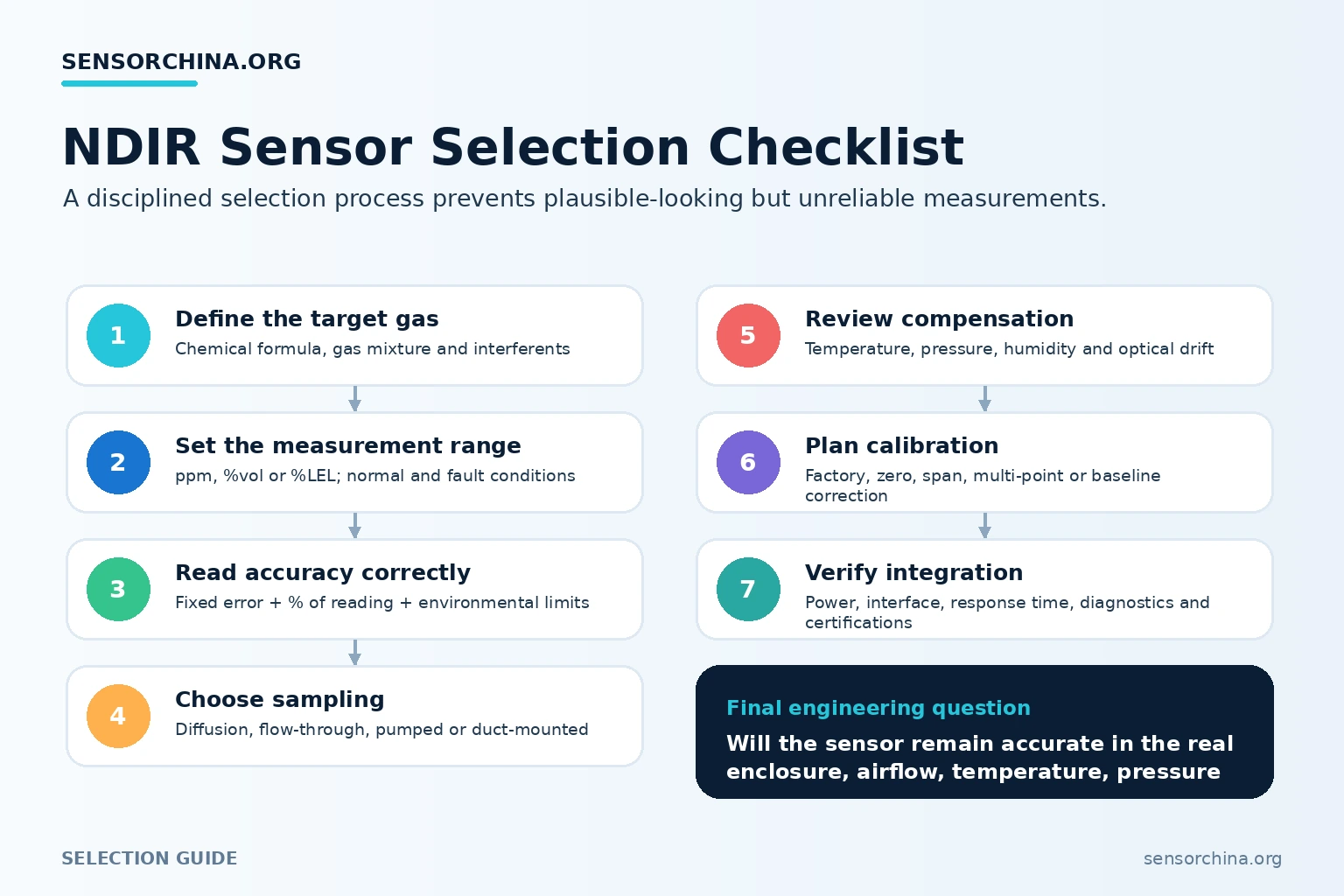
Start with the target gas and real operating conditions before comparing module specifications.
1. Define the exact target gas
Specify:
- Chemical name and formula
- Expected gas mixture
- Possible interfering gases
- Whether one gas or a broader gas group must be measured
- Whether multiple gases must be distinguished
Do not select a sensor using only a broad description such as “combustible gas” or “refrigerant.”
2. Match the measurement range to the application
A sensor optimized for 0–5,000 ppm CO₂ is not automatically suitable for percentage-level process gas.
Similarly, a broad 0–100% range may not provide the required low-level resolution.
3. Read the complete accuracy specification
Accuracy may combine:
- Fixed error in ppm
- Percentage of reading
- Percentage of full scale
- Temperature-dependent error
- Pressure-dependent error
- Repeatability
- Long-term drift
For example, an accuracy statement of ±50 ppm + 3% of reading contains both a fixed and proportional component.
4. Verify response-time test conditions
Check whether the stated response time was measured using:
- Direct gas injection
- Controlled flow
- Diffusion through a membrane
- A protective enclosure
- Digital averaging or filtering
The response of the final product may be significantly slower than the bare sensor module.
5. Understand compensation responsibility
Determine whether temperature and pressure compensation are:
- Built into the module
- Available only within a specified range
- Based on actual pressure measurement
- Based on a fixed pressure assumption
- Performed by the host controller
6. Choose a realistic calibration strategy
Possible calibration methods include:
- Factory calibration
- Zero calibration
- Span calibration
- Two-point calibration
- Multi-point calibration
- Automatic baseline correction
- Field calibration using certified gas
The correct choice depends on whether the application periodically reaches a known reference concentration.
7. Confirm electrical and mechanical integration
Review:
- Supply voltage
- Peak and average current
- UART, I²C, PWM, analog or RS-485 output
- Warm-up time
- Diagnostic and fault information
- Dimensions and gas-inlet position
- Enclosure airflow
- EMC requirements
- Safety and application certifications
Questions to Ask an NDIR Sensor Supplier
| Selection area | Questions to ask |
|---|---|
| Target and interference | Which gases were included in selectivity and cross-sensitivity testing? |
| Accuracy | At what temperature, humidity, pressure and concentration was accuracy specified? |
| Calibration | Can automatic baseline correction be disabled? Which zero and span gases are supported? |
| Response | Is the response specification for the sensing core or the final protected module? |
| Lifetime | Which component is expected to limit service life? |
| Diagnostics | Can the host detect optical failure, out-of-range data and calibration status? |
NDIR Sensor Calibration Explained
Zero calibration
The sensor is exposed to a gas containing none of the target gas.
For CO₂, high-purity nitrogen is commonly used when the product instructions specify a true zero calibration.
Span calibration
The sensor is exposed to a certified concentration of the target gas.
Flow, pressure, temperature and stabilization time should follow the manufacturer’s procedure.
Two-point and multi-point calibration
Two-point calibration establishes low and high reference points.
Multi-point calibration better represents nonlinear response across a wide range and is often important when the application spans several orders of concentration.
Automatic baseline correction
Automatic baseline correction, often abbreviated as ABC, assumes the sensor periodically encounters a known low concentration.
In a normally ventilated indoor space, the algorithm may use the lowest stable reading over several days as an outdoor-air reference.
ABC should not be enabled blindly in:
- Greenhouses
- Continuously occupied rooms
- Livestock buildings
- Underground spaces
- Refrigerated storage
- Industrial processes
- Areas that never reach outdoor background CO₂ levels
In these environments, ABC may gradually move an otherwise stable reading in the wrong direction.
Common NDIR Sensor Misconceptions
“NDIR sensors never require calibration”
NDIR technology can provide good stability, but the source, detector, optics and electronics can still change over time.
Calibration requirements depend on the sensor design and application.
“One methane sensor measures every combustible gas accurately”
Many hydrocarbons absorb in related infrared regions, but their response factors are not identical.
A methane-calibrated sensor may respond to propane without reporting the propane concentration accurately.
“A dual-channel sensor corrects every environmental error”
A reference channel can reduce common optical drift, but it cannot eliminate every temperature, pressure, humidity, contamination or interference effect.
“A wider measurement range is always better”
A very wide range may reduce useful resolution or accuracy at the low end.
The optical path and calibration should match the concentrations that matter in the actual application.
“NDIR can identify any gas”
An NDIR sensor measures only the wavelength bands for which it was designed.
A single-channel NDIR sensor is not a general-purpose infrared spectrometer.
Frequently Asked Questions
What does NDIR stand for?
NDIR stands for non-dispersive infrared. It is an optical gas-measurement method that determines concentration from selective infrared absorption.
How does an NDIR sensor work?
An infrared source shines through a gas chamber. The target gas absorbs a characteristic wavelength, an optical filter selects that band, and the detector measures the remaining infrared energy. Calibration and compensation convert the signal into concentration.
Which gases can NDIR sensors detect?
NDIR is commonly used for infrared-active gases such as carbon dioxide, methane, carbon monoxide, hydrocarbons, refrigerants, nitrous oxide and sulfur hexafluoride.
The sensor must use the correct optical filter and calibration for the target gas.
Can NDIR detect oxygen or hydrogen?
Conventional NDIR is generally not used for oxygen, hydrogen or nitrogen because these gases do not provide the strong practical mid-infrared absorption bands used by standard NDIR sensors.
What is the difference between single-channel and dual-channel NDIR?
A single-channel design measures the active absorption band.
A dual-channel design also measures a reference band that is minimally affected by the target gas, helping track source aging and common optical losses.
Does an NDIR sensor need calibration?
Yes.
NDIR sensors can be stable, but source output, detector sensitivity, optical surfaces and mechanical stress can change over time.
Is NDIR better than an electrochemical sensor?
Neither technology is universally better.
NDIR is often preferred for suitable infrared-active gases when selectivity, long life and non-consumptive measurement are priorities.
Electrochemical sensors are often preferred for low-power, low-ppm toxic-gas or oxygen measurement.
What affects NDIR sensor accuracy?
Accuracy can be influenced by temperature, pressure, humidity, spectral interference, optical contamination, condensation, gas flow, response filtering, calibration quality and final enclosure design.
Conclusion
NDIR is a mature and widely used method for measuring infrared-active gases.
Its principle is straightforward: transmit infrared light through a gas sample, isolate a target absorption band and convert the detected energy loss into concentration.
Reliable NDIR performance depends on the complete system. The infrared source, optical filter, detector, optical path, gas inlet, environmental compensation, calibration model and final enclosure all affect the result.
Engineers should therefore select an NDIR sensor around the exact gas, concentration range and operating conditions—not around the NDIR label alone.
